
Table of Contents
- Understanding Foot Care Instruments in Nursing Practice
- Podiatry Drills in Nursing Foot Care
- Infection Prevention and Equipment Reprocessing
- Scope of Practice and Regulatory Considerations in Canada
- Common Misconceptions About Foot Care Tools
- Professional Considerations for Instrument Purchasing
- Education and Competency Development
- Key Takeaways
- FAQs
Instrument Selection and Drill Use in Foot Care
Instrument Selection and Drill Use in Foot Care is a foundational competency for Canadian nurses providing foot care services. With a growing range of podiatry tools, burrs, and mechanical devices available on the market, nurses must understand not only how to use instruments safely but also how to select them appropriately within their scope of practice.
Foot care nursing requires clinical judgment, infection prevention knowledge, and technical skill. Education in instrument selection and drill use supports safe care delivery and reduces the risk of injury, cross-contamination, and equipment misuse. As with all nursing practice in Canada, the scope of practice varies by province and employer policy. Education provides knowledge; it does not independently authorize practice.
Understanding Foot Care Instruments in Nursing Practice
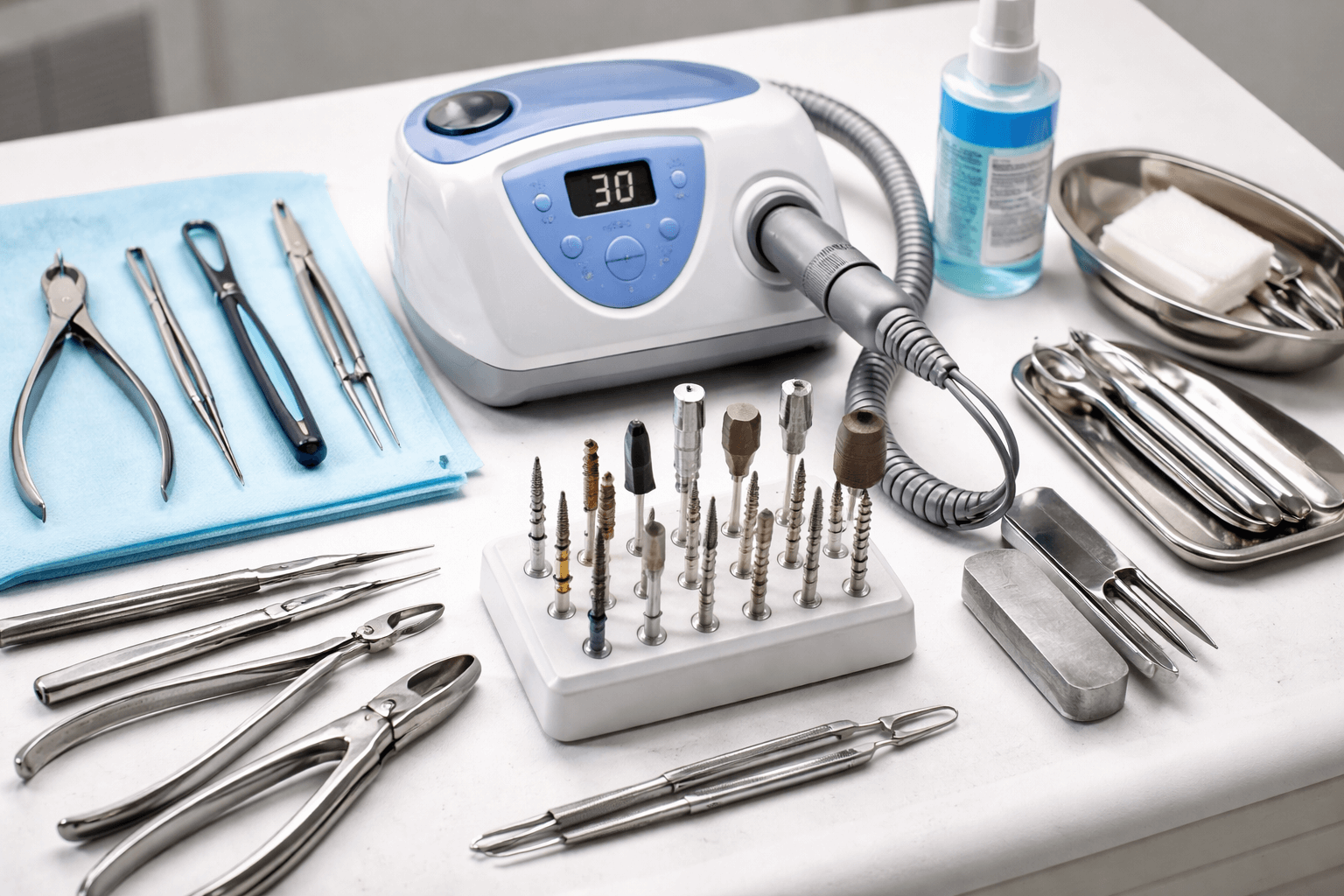
Foot care nurses use a variety of hand instruments and mechanical devices to address common concerns such as callus buildup, thickened nails, and fungal nail reduction.
Common Categories of Instruments
Manual cutting instruments
Scalpels
Curettes
Nail nippers
Corn blades (where permitted by scope and employer policy)
Mechanical reduction tools
Podiatry drills
Rotary handpieces
Diamond or carbide burrs
Specialty tools
Ingrown nail lifters
Nail splitters
Files and abrasive tools
Proper instrument selection depends on:
Client assessment findings
Tissue type (nail vs. callus)
Thickness and density
Infection control requirements
Nurse competence and training
Nurses expanding their knowledge may review structured learning in foundational foot care nursing education to understand the rationale behind tool selection and technique.
Podiatry Drills in Nursing Foot Care
Mechanical drills are commonly used for reducing thickened nails and managing fungal nail changes. Instrument Selection and Drill Use in Foot Care requires understanding both the equipment and the associated risks.
Key Components of a Podiatry Drill System
| Component | Purpose |
|---|---|
| Handpiece | Holds and rotates the burr |
| Motor unit | Controls speed and torque |
| Burr | Performs mechanical reduction |
| Dust extraction (if available) | Reduces airborne particles |
Burr Selection Considerations
Burr selection must align with the intended purpose:
Diamond burrs: Smoother finish, often used for refinement
Carbide burrs: More aggressive reduction
Coarse vs. fine grit: Determines level of tissue removal
Using an inappropriate burr can lead to heat generation, discomfort, or tissue injury. Nurses must understand speed control, pressure management, and hand stability.
Further study in clinical skills and tools education supports safer mechanical technique development.
Infection Prevention and Equipment Reprocessing
Instrument Selection and Drill Use in Foot Care must always align with infection prevention standards. Reprocessing protocols are governed by provincial guidelines, employer policies, and national best practices.
Key considerations include:
Classification of instruments (critical, semi-critical, non-critical)
Cleaning prior to sterilization
Packaging and storage
Documentation of reprocessing cycles
Surface disinfection of drill units
Improper cleaning of burrs or handpieces can increase cross-contamination risk. Nurses should have formal education in infection prevention and medical device reprocessing to ensure compliance.
It is important to note that manufacturer instructions for use (IFUs) must always guide cleaning and sterilization methods.
Scope of Practice and Regulatory Considerations in Canada
In Canada, the scope of practice is defined by:
Provincial nursing regulatory bodies
Employer policies
Individual competence
Practice setting
Education in Instrument Selection and Drill Use in Foot Care supports competence development. However, completing a course provides a certificate of completion — not authorization to practise beyond the regulated scope.
Before integrating mechanical drills into practice, nurses should confirm:
That the procedure aligns with their regulated scope
Those employer policies permit use
That liability coverage is appropriate
That they have documented education and competence
For deeper review, nurses may consult the scope of practice education resources designed for foot care nursing.
Common Misconceptions About Foot Care Tools
“More expensive tools are always better.”
Cost does not determine suitability. Instrument quality, compatibility, durability, and reprocessing requirements are more important than price alone.
“Drills are safer than manual tools.”
Drills reduce manual strain but introduce mechanical risk. Without proper training, drills can cause friction burns or excessive nail reduction.
“All burrs can be cleaned the same way.”
Different materials require specific cleaning and sterilization processes. Manufacturer guidelines must always be followed.
“Taking a course automatically expands scope.”
Education enhances competence but does not change regulatory scope. Nurses must practise within professional standards.
Professional Considerations for Instrument Purchasing
When selecting tools for a foot care practice, nurses should consider:
Clinical population served (long-term care, community, private clients)
Portability needs (bag vs. cart setup)
Maintenance and servicing availability
Replacement part access
Compatibility with sterilization systems
A thoughtful setup reduces workflow inefficiencies and supports ergonomic practice. Nurses returning to foot care practice may benefit from reviewing returning-to-practice education content to ensure current standards are met.
Education and Competency Development
Instrument Selection and Drill Use in Foot Care is a technical skill set that benefits from structured education, supervised practice, and ongoing professional development.
Competency includes:
Understanding tissue response
Recognizing contraindications
Maintaining client comfort
Managing unexpected outcomes
Applying infection prevention principles
Ongoing professional development through the AFCN Learning Institute education hub supports evidence-informed practice and ethical service delivery.
Ergonomics and Nurse Safety in Mechanical Foot Care
Instrument Selection and Drill Use in Foot Care also includes consideration of nurse ergonomics and occupational health. Mechanical devices can reduce repetitive strain associated with manual filing and cutting. However, improper positioning or prolonged drill use may contribute to wrist, shoulder, or neck strain.
Nurses should evaluate:
Handpiece weight and vibration levels
Cord flexibility and length
Chair height and client positioning
Lighting and magnification
Break frequency during extended clinics
Appropriate ergonomic setup supports long-term practice sustainability. Employers may have occupational health policies related to repetitive strain prevention, and nurses in independent practice should proactively assess their workspace layout.
Key Takeaways
Instrument Selection and Drill Use in Foot Care requires structured education and technical competence.
Tool selection must align with the scope of practice, employer policy, and provincial regulations.
Burr type, speed control, and pressure management affect safety outcomes.
Infection prevention and proper reprocessing are essential components of safe practice.
Education provides a certificate of completion and supports competence — it does not independently authorize expanded practice.
Foot care nursing requires careful clinical judgment, technical skill, and adherence to professional standards. Thoughtful instrument selection and appropriate drill use contribute to safe, ethical care delivery. Nurses should pursue structured education, confirm regulatory alignment, and maintain ongoing professional development to support competent foot care practice in Canada.
https://www.afcnlearninginstitute.com/courses/footcaretoolsanddrills
FAQs
What is included in Instrument Selection and Drill Use in Foot Care education?
Education typically includes understanding foot care instruments, burr selection, mechanical drill operation, infection prevention standards, and scope-of-practice considerations for Canadian nurses.
Can Canadian nurses use podiatry drills in foot care practice?
Use of podiatry drills depends on provincial scope of practice, employer policy, and individual competence. Education supports skill development but does not independently authorize expanded practice.
How do nurses choose the correct burr for fungal nail reduction?
Burr selection depends on nail thickness, desired reduction level, and manufacturer guidance. Proper training is necessary to manage speed, pressure, and heat generation safely.
Does completing a foot care instrument course provide certification?
Courses provide a certificate of completion. Authorization to practise is determined by provincial regulatory bodies and employer policies, not by course completion alone.