
Table of Contents
- Understanding Onychomycosis in Nursing Practice
- Scope of Practice Considerations in Canada
- Comprehensive Assessment and Differential Considerations
- Mechanical Nail Reduction
- Topical Antifungal Therapies
- Oral Antifungal Medications
- Device-Based and Adjunctive Therapies
- Infection Prevention and Instrument Reprocessing
- Addressing Common Misunderstandings
- Professional Insight From a Nursing Education Perspective
- Documentation and Professional Accountability
- Risk Stratification in High-Risk Populations
- Risk Stratification in High-Risk Populations
- Environmental Considerations in Clinical and Home Settings
- Ongoing Professional Development
- Key Takeaways
- FAQs
Fungal Nail Treatments In Your Foot Care Practice
Fungal Nail Treatments In Your Foot Care Practice are a clinically relevant component of Canadian foot care nursing. Onychomycosis affects a significant portion of adult and older adult populations, particularly individuals living with diabetes, peripheral vascular disease, or mobility limitations. For nurses delivering foot care services, understanding assessment, reduction techniques, treatment categories, and infection prevention standards is essential for safe and ethical integration of Fungal Nail Treatments In Your Foot Care Practice.
This article outlines evidence-informed principles that support competent decision-making while respecting provincial scope of practice and employer policies.
Understanding Onychomycosis in Nursing Practice
Before implementing Fungal Nail Treatments In Your Foot Care Practice, nurses must understand the pathology of fungal nail infections.
Onychomycosis is an infection of the nail unit caused by dermatophytes, yeasts, or non-dermatophyte moulds. Clinical presentation may include:
Thickened nail plate
Yellow, white, or brown discoloration
Subungual debris
Onycholysis (nail separation)
Brittleness or distortion
Although sometimes perceived as cosmetic, fungal nails can contribute to pressure, discomfort, and increased ulcer risk in vulnerable populations.
Sound clinical reasoning supports safe delivery of fungal nail management in foot care nursing, particularly in high-risk clients.
Scope of Practice Considerations in Canada
Fungal Nail Treatments In Your Foot Care Practice must align with:
Provincial nursing regulatory standards
Employer policies
Individual competence
Infection prevention and control requirements
Important distinctions:
A certificate of completion does not equal certification.
Education does not independently expand scope of practice.
Prescribing oral antifungals is restricted to authorized providers.
Diagnostic authority varies across provinces.
Nurses must ensure that any services related to fungal nail care in practice remain within clearly defined professional boundaries.
Comprehensive Assessment and Differential Considerations
Safe integration of Fungal Nail Treatments In Your Foot Care Practice begins with structured assessment.
Assessment components include:
Medical history (diabetes, vascular disease, immunosuppression)
Medication review
Footwear assessment
Nail appearance and duration of changes
Skin integrity and pressure areas
Pain or secondary infection indicators
Not all nail dystrophy is fungal in origin. Differential considerations may include psoriasis, trauma-related nail changes, or age-related thickening.
When findings are unclear, referral for diagnostic confirmation may be appropriate before continuing fungal nail management.
Mechanical Nail Reduction
Mechanical reduction is often central to fungal nail management in clinical practice.
Thickened nails may:
Increase pressure in footwear
Contribute to skin breakdown
Limit mobility
Reduce hygiene effectiveness
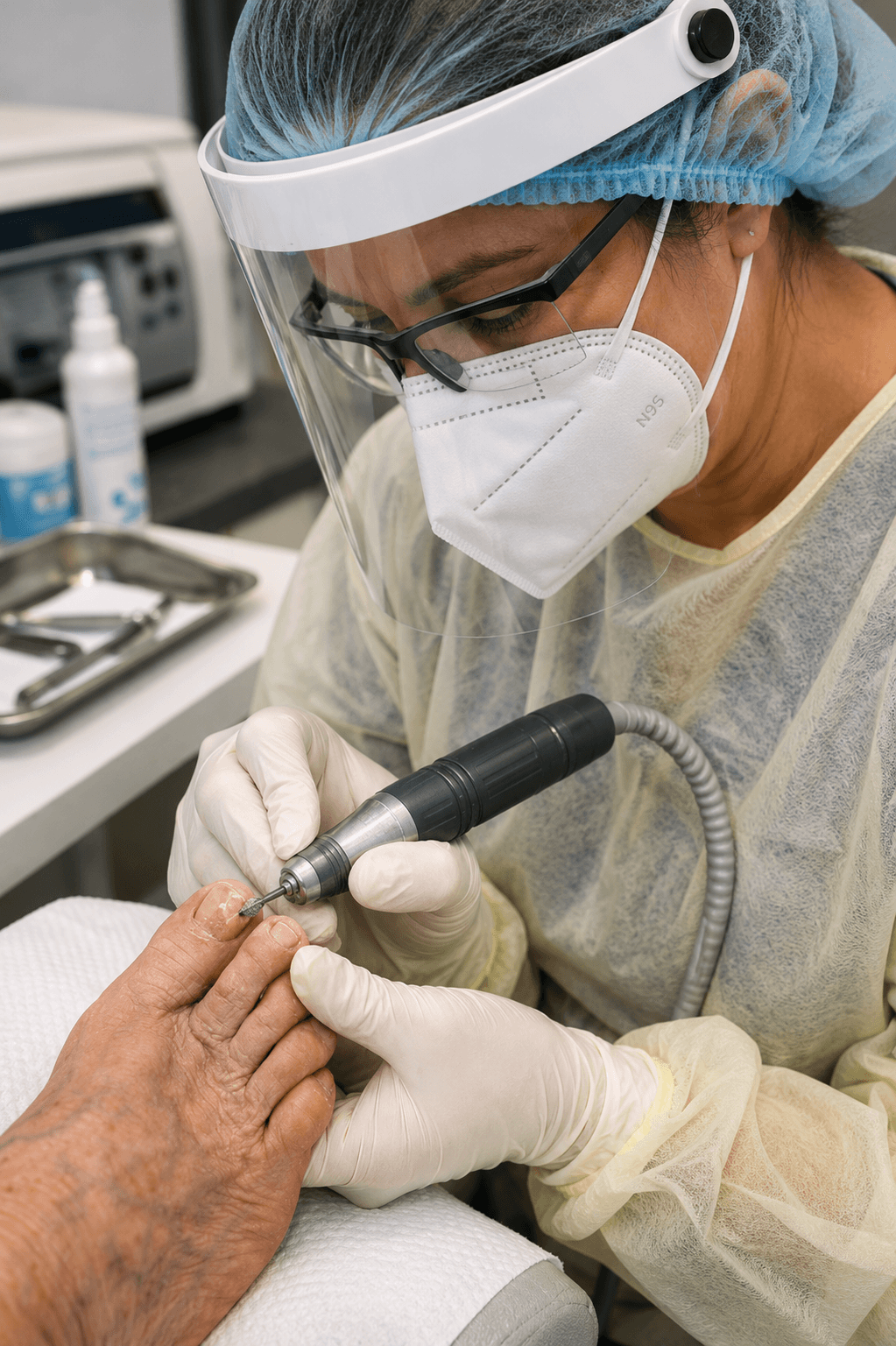
Mechanical reduction using appropriate burrs and nippers can:
Decrease nail thickness
Improve comfort
Reduce fungal load
Enhance penetration of prescribed topical agents
It is important to clarify that reduction improves manageability but does not eradicate infection. Conservative technique, continuous visualization, and attention to vascular status are essential when providing fungal nail reduction services.
Topical Antifungal Therapies
Topical therapies are often discussed in the context of fungal nail infection management.
Nurses may provide education regarding:
Correct application methods
Duration of therapy
Realistic timelines for improvement
Potential skin irritation
Because toenails grow slowly, visible change may take several months. Clear communication helps align expectations when supporting clients receiving fungal nail care.
Oral Antifungal Medications
Oral antifungal therapy may be considered for certain clients under the direction of an authorized prescriber.
While nurses typically do not initiate systemic treatment independently, understanding:
Contraindications
Potential drug interactions
Required monitoring
Adherence considerations
supports safe collaboration within interprofessional care when discussing Fungal Nail Treatments In Your Foot Care Practice.
Device-Based and Adjunctive Therapies
Laser and device-based therapies are present in some care settings. Before incorporating such options into Fungal Nail Treatments In Your Foot Care Practice, nurses must confirm:
Regulatory authorization
Competency training
Equipment maintenance standards
Reprocessing requirements
Documentation practices
Due diligence protects both clients and practitioners.
Infection Prevention and Instrument Reprocessing
Infection prevention is foundational to Fungal Nail Treatments In Your Foot Care Practice.
Essential elements include:
Cleaning before sterilization
Proper packaging of instruments
Validated sterilization cycles
Documentation of reprocessing
Environmental surface disinfection
Hand hygiene compliance
Fungal organisms can persist in improperly reprocessed equipment. Strict adherence to reprocessing standards minimizes cross-contamination risk when providing Fungal Nail Treatments In Your Foot Care Practice.
Addressing Common Misunderstandings
Clear education strengthens client understanding.
Common misconceptions include:
Mechanical reduction cures infection.
Over-the-counter products work quickly.
Fungal nails are purely cosmetic.
Education automatically expands nursing scope.
Professional communication ensures that Fungal Nail Treatments In Your Foot Care Practice are framed realistically and ethically.
Professional Insight From a Nursing Education Perspective
From a nursing education standpoint, competence in Fungal Nail Treatments In Your Foot Care Practice requires more than procedural skill.
It involves:
Clinical reasoning
Risk stratification
Knowledge of regulatory boundaries
Infection control proficiency
Documentation accuracy
Referral judgment
Ethical client communication
Integrating Fungal Nail Treatments In Your Foot Care Practice should reflect structured learning, ongoing professional development, and adherence to Canadian regulatory expectations.
Documentation and Professional Accountability
Accurate documentation supports safe delivery of Fungal Nail Treatments In Your Foot Care Practice and protects both the client and the nurse.
Documentation should include:
Assessment findings
Risk classification (if used in your setting)
Description of nail condition
Interventions performed
Client tolerance of procedure
Education provided
Referral recommendations (if applicable)
Clear charting demonstrates clinical reasoning and supports continuity of care. When providing Fungal Nail Treatments In Your Foot Care Practice, documentation should reflect not only what was done, but why it was clinically appropriate.
In regulated health professions, documentation is a professional and legal responsibility. It must reflect objective observations and avoid diagnostic statements outside scope.
Risk Stratification in High-Risk Populations
Not all clients receiving Fungal Nail Treatments In Your Foot Care Practice present with the same level of risk.
Higher-risk populations may include:
Individuals with diabetes
Clients with peripheral arterial disease
Clients with neuropathy
Immunocompromised individuals
Older adults with frailty
In these populations, thickened fungal nails may increase pressure, alter gait, or contribute to skin breakdown.
When delivering Fungal Nail Treatments In Your Foot Care Practice in high-risk clients, nurses should:
Proceed conservatively
Monitor tissue response closely
Adjust reduction depth appropriately
Reassess vascular status regularly
Refer promptly if concerns arise
Risk-aware practice strengthens safety and reflects advanced clinical judgment.
Environmental Considerations in Clinical and Home Settings
Fungal Nail Treatments In Your Foot Care Practice may be delivered in clinics, long-term care facilities, or client homes.
Each environment presents unique considerations.
In clinic settings:
Maintain structured reprocessing workflows
Separate clean and dirty zones
Ensure proper ventilation
In home settings:
Use portable protective barriers
Maintain instrument separation
Follow transport protocols for contaminated equipment
Environmental awareness reduces contamination risk and reinforces infection prevention standards.
Ongoing Professional Development
Competence in Fungal Nail Treatments In Your Foot Care Practice requires ongoing learning.
Continuing education may focus on:
Updated infection control standards
Advances in topical therapies
Safe use of mechanical equipment
Documentation best practices
Regulatory updates
Professional growth supports confidence and reinforces safe integration of Fungal Nail Treatments In Your Foot Care Practice within evolving standards of nursing care.
Key Takeaways
Fungal Nail Treatments In Your Foot Care Practice require structured assessment and regulatory awareness.
Mechanical reduction improves comfort but does not cure infection.
Topical and oral therapies require clear client education and appropriate referral.
Infection prevention and instrument reprocessing are essential.
Scope of practice varies by province and employer policy.
Fungal Nail Treatments In Your Foot Care Practice represent a meaningful component of comprehensive foot care nursing in Canada. When grounded in assessment, regulatory compliance, and infection prevention standards, they support client comfort and lower limb health while maintaining professional accountability.
https://www.afcnlearninginstitute.com/courses/foot-care-skills-workshop-series-fungal-nail-treatment
FAQs
Can nurses independently treat fungal toenails in Canada?
Nurses may provide mechanical reduction and client education within their scope of practice. Prescribing oral antifungals or making medical diagnoses depends on provincial regulations and authorization.
Does mechanical reduction cure onychomycosis?
No. Mechanical reduction decreases thickness and fungal load but does not eliminate the infection.
Are topical antifungals effective for fungal nails?
Topical treatments may be effective in mild cases but require consistent, prolonged use. Results vary and improvement is gradual.
Is education enough to expand a nurse’s scope of practice?
No. Completing education provides a certificate of completion but does not independently authorize expanded practice. Nurses must follow provincial regulatory and employer guidelines.