AFCN Foot Care Nurse Business Mastery Program
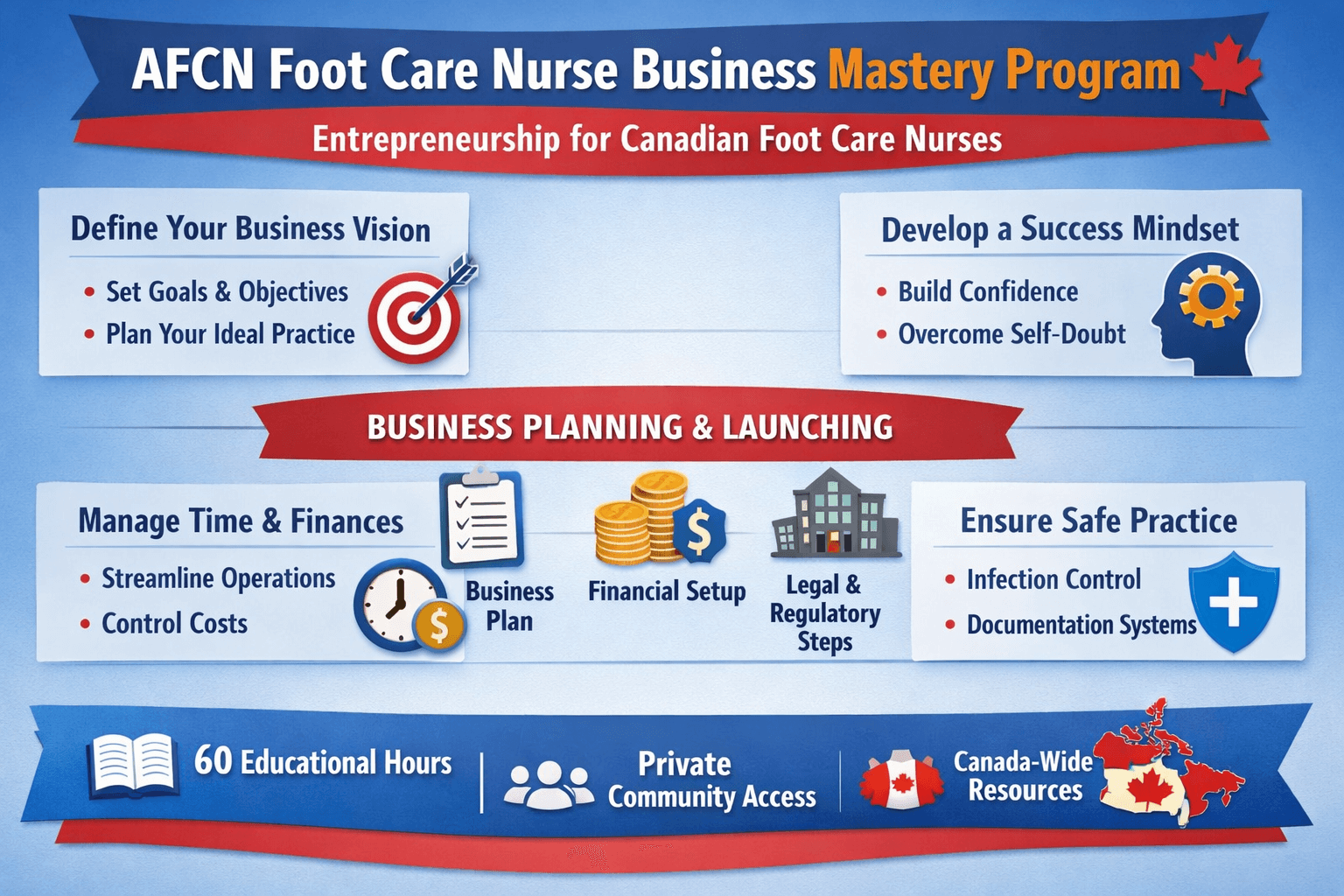
The AFCN Foot Care Nurse Business Mastery Program is an entrepreneurship education program developed for Canadian licensed nurses who are building or refining a professional foot care nursing practice. This structured program focuses on systems development, compliance awareness, strategic planning, and leadership skills within the realities of Canadian nursing regulation.
The AFCN Foot Care Nurse Business Mastery Program was developed in response to the increasing number of Canadian nurses seeking structured guidance when transitioning into independent foot care practice.
Foot care nursing is a clinical service grounded in assessment, risk awareness, infection prevention, and documentation standards. Operating a foot care nursing business adds another layer of responsibility. Nurses must understand not only clinical standards, but also documentation systems, financial structure, time management, professional boundaries, privacy considerations, and provincial scope requirements.
This program addresses the business framework required to support safe and sustainable practice within the Canadian regulatory environment.
The AFCN Foot Care Nurse Business Mastery Program is structured as a step-by-step educational pathway covering foundational business principles tailored specifically to Canadian Foot Care Nurses. The program acknowledges that independent practice requires thoughtful planning and professional accountability.
The curriculum includes:
91 structured lessons
Approximately 5 hours of video education
60 educational hours
Canada-wide provincial checklist resource
Private professional community access
Live Q&A session with an experienced foot care nurse
The content is organized into progressive chapters that guide nurses from early vision development through operational systems, documentation structure, and long-term planning. Each module builds on the previous one to support clarity and reduce uncertainty when transitioning into or refining independent practice.
Key Concepts Covered in the Program
1. Clarifying Business Vision and Measurable Goals
Nurses are guided to define:
Professional objectives
Income sustainability targets
Work-life structure
Clinical service model (mobile, clinic, hybrid)
Goal setting is approached using measurable frameworks aligned with ethical nursing practice. Rather than focusing on rapid expansion, the emphasis is on clarity, sustainability, and alignment with scope of practice.
Structured planning helps nurses evaluate whether their business model supports safe caseload volume, appropriate documentation time, and professional development.
2. Developing a Professional Growth Mindset
Entrepreneurship in healthcare requires:
The curriculum explores cognitive barriers such as self-doubt and imposter syndrome from a professional development perspective. Nurses transitioning into independent practice often shift from structured employment environments to autonomous decision-making. This shift requires confidence grounded in competence, regulatory awareness, and ethical reasoning.
Professional growth is framed as an ongoing process. Continuing education, peer discussion, and reflective practice remain essential components of long-term success.
3. Designing a Sustainable Business Model
The program addresses:
Target market identification
Value positioning within scope
Revenue planning
Service model structure
Ethical marketing principles
Importantly, nurses are reminded that education does not replace provincial regulatory guidance. The scope of practice varies by province and employer, and independent practice requirements must be verified through the appropriate regulatory body.
For nurses reviewing scope considerations, the scope of practice education resource within the AFCN Learning Institute provides foundational clarification.
A sustainable business model also requires realistic scheduling structures, clear service boundaries, and documented policies for cancellations, referrals, and escalation of care.
4. Launch Planning and Operational Structure
The AFCN Foot Care Nurse Business Mastery Program includes structured guidance on:
Business planning fundamentals
Financial considerations and budgeting
Business registration and paperwork awareness
Annual strategic goal development
Operational readiness includes awareness of privacy legislation, documentation storage practices, and consent processes. Nurses are encouraged to understand their provincial health information privacy requirements and ensure systems are compliant.
While business education is provided, nurses remain responsible for consulting qualified legal and accounting professionals when required. The program does not provide legal or financial advice.
For additional regulatory awareness, nurses may refer to the AFCN Learning Institute education hub for professional standards content.
5. Time, Systems, and Financial Management
Operational efficiency is essential in foot care nursing practice. Topics include:
Clinic and mobile equipment planning
Task prioritization
Cost management strategies
Preventing burnout
Balancing administrative and clinical time
Independent nurses must allocate time for documentation, supply management, equipment maintenance, continuing education, and quality improvement processes. Without systems in place, administrative tasks can compromise clinical focus.
Safe practice also requires structured infection prevention processes. Nurses are encouraged to integrate principles from infection prevention and medical device reprocessing education into their business systems to maintain consistent safety standards.
Scope of Practice
Completion of the AFCN Foot Care Nurse Business Mastery Program results in a certificate of completion. It does not grant certification, licensure, or expanded scope.
Nurses must:
Confirm independent practice regulations in their province
Maintain professional liability insurance
Follow employer policies if applicable
Document services according to regulatory standards
Education supports knowledge development. Authorization to practise independently is determined by the nurse’s provincial regulatory body and, where applicable, employer policies.
Ethical Marketing and Professional Boundaries
Foot care nurses operate within a healthcare context. Marketing must remain:
The program emphasizes ethical communication consistent with nursing codes of ethics across Canadian jurisdictions. Transparency regarding services, fees, and limitations protects both the nurse and the client.
For foundational clinical preparation, nurses should complete foundational foot care nursing education prior to focusing on business development.
Systems-Based Safety
A sustainable foot care practice requires:
Clear intake documentation
Informed consent processes
Incident reporting systems
Infection control protocols
Equipment maintenance logs
These systems reduce risk, support continuity of care, and provide defensible documentation. Nurses expanding services may benefit from reviewing clinical skills and tools education to ensure procedural competence aligns with service offerings.
Common Misconceptions About Business Education for Nurses
Misconception 1: Clinical skill alone guarantees business success.
Clinical competence is essential but does not replace operational structure, scheduling systems, and financial planning.
Misconception 2: Entrepreneurship conflicts with nursing ethics.
When structured appropriately, independent practice can align fully with professional standards and codes of ethics.
Misconception 3: Business education provides automatic compliance.
Regulatory compliance remains the responsibility of the individual nurse and must be verified provincially.
Misconception 4: A certificate of completion equals authorization to practise.
Education supports knowledge development. Authorization is determined by regulatory bodies.
Nurses returning to the workforce may also review professional development and returning-to-practice resources before launching independent services.
Professional Insight from a Nursing Education Perspective
Business structure in healthcare is not about sales tactics. It is about:
Protecting professional integrity
Creating sustainable income
Preventing burnout
Maintaining clinical standards
Supporting long-term patient care access
The AFCN Foot Care Nurse Business Mastery Program approaches entrepreneurship through the lens of nursing accountability. Systems, documentation, and strategic planning reduce risk and enhance consistency. Structured processes allow nurses to focus on patient care rather than reactive problem-solving.
A structured business model supports ethical care delivery and professional longevity.
Key Takeaways
The AFCN Foot Care Nurse Business Mastery Program provides structured entrepreneurship education for Canadian foot care nurses.
Education supports knowledge development but does not replace regulatory authorization.
The scope of practice varies by province and employer.
Sustainable practice requires systems, documentation, and infection control integration.
Ethical marketing and professional boundaries remain essential in independent practice.
Business education complements clinical competence; it does not replace it.
Building a foot care nursing practice requires both clinical skill and operational clarity. Nurses considering independent practice should ensure their education aligns with provincial standards and professional accountability frameworks. Structured business education can support long-term sustainability when grounded in ethical nursing principles.