
Table of Contents
- Understanding Medical Reprocessing Standards for Foot Care Nurses
- Professional and Regulatory Considerations in Canada
- The Reprocessing Workflow in Foot Care Practice
- Common Misconceptions in Foot Care Reprocessing
- Education and Competency Development
- Risk Management and Client Safety
- Key Takeaways
- Ethical Closing Statement
- FAQs
Medical Reprocessing Standards for Foot Care Nurses
Medical Reprocessing Standards for Foot Care Nurses are a foundational component of safe, ethical, and regulatory-aligned foot care practice in Canada. Nurses who provide foot care services routinely handle reusable instruments that come into contact with skin, nails, and, in some cases, compromised tissue. Appropriate cleaning, disinfection, and sterilization procedures are therefore essential to reduce infection risk and protect both clients and practitioners.
Across Canadian provinces and territories, expectations related to infection prevention and control (IPAC) continue to evolve. While the scope of practice varies by province and employer, all licensed nurses are accountable for practicing in accordance with current standards, employer policies, and public health requirements. Education in reprocessing supports competence but does not, on its own, authorize independent practice.
This article outlines key principles, definitions, and professional considerations related to Medical Reprocessing Standards for Foot Care Nurses in Canadian health care settings.
Understanding Medical Reprocessing Standards for Foot Care Nurses
Medical Reprocessing Standards for Foot Care Nurses refer to the structured processes used to safely clean, disinfect, and sterilize reusable medical devices used in foot care. These standards are informed by:
Provincial public health guidance
Infection prevention and control best practices
Manufacturer instructions for use (IFU)
Canadian Standards Association (CSA) guidance
Employer and facility-specific policies
Reprocessing is not a single step. It is a multi-stage process designed to reduce microbial load and prevent cross-contamination.
Key Definitions
Cleaning
Removal of visible soil and organic material from instruments using water, detergent, and mechanical action.
Disinfection
A process that eliminates many or all pathogenic microorganisms, except bacterial spores, depending on the level used (low, intermediate, or high-level).
Sterilization
A validated process that destroys all forms of microbial life, including spores. Steam sterilization (autoclaving) is commonly used for critical foot care instruments when compatible with device instructions.
Critical Devices
Instruments that enter sterile tissue or contact compromised skin must be sterilized.
Non-Critical Equipment
Items that contact intact skin only and typically require cleaning and low-level disinfection.
Understanding these distinctions is essential when applying Medical Reprocessing Standards for Foot Care Nurses in daily practice.
Professional and Regulatory Considerations in Canada
1. Scope of Practice
In Canada, the nursing scope of practice is defined by provincial or territorial regulatory bodies. Reprocessing responsibilities may fall within nursing duties in some settings, while in others, medical device reprocessing may be delegated or centralized.
It is important to understand that:
Scope varies by province and employer.
Additional employer authorization may be required.
Completing an educational program provides a certificate of completion, not certification or independent authority to practice.
For guidance on regulatory expectations, nurses may consult resources such as the scope of practice education resources available through AFCN’s education hub.
2. Infection Prevention and Control (IPAC)
Foot care nurses must align reprocessing practices with IPAC principles, including:
Standard precautions
Hand hygiene protocols
Appropriate use of personal protective equipment (PPE)
Environmental cleaning
Instrument transport procedures
Education in infection prevention and medical device reprocessing supports nurses in understanding validated processes and documentation requirements.
3. Documentation and Traceability
Documentation is a key safety component. Depending on the setting, nurses may need to record:
Sterilizer cycle parameters
Biological or chemical indicator results
Load records
Maintenance logs
Traceability processes support quality assurance and public health compliance.
The Reprocessing Workflow in Foot Care Practice
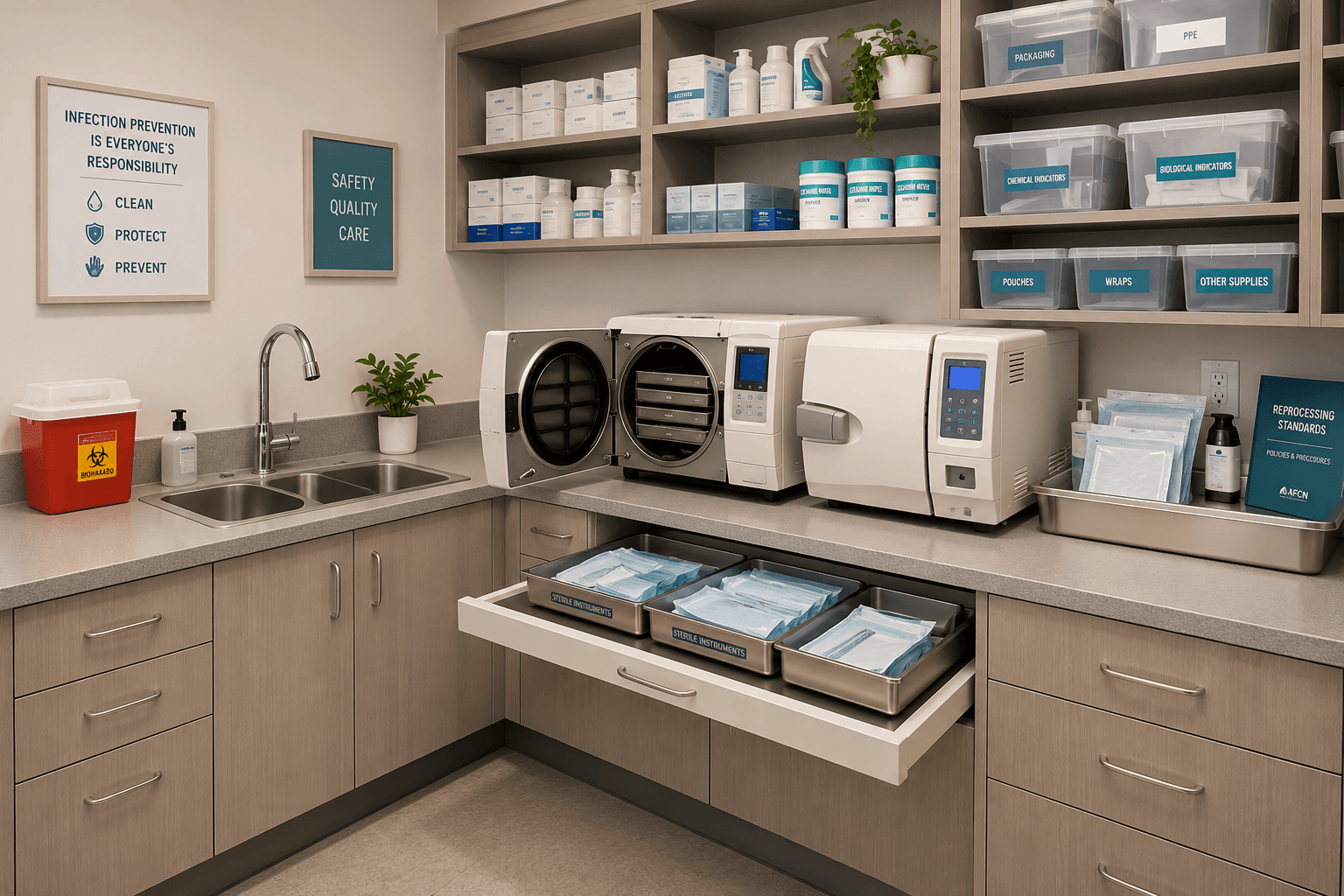
A structured workflow supports consistent adherence to Medical Reprocessing Standards for Foot Care Nurses. While policies vary by setting, the general sequence includes:
Point-of-Use Care
Remove gross debris immediately after use.
Keep instruments moist if immediate cleaning is not possible.
Cleaning
Manual or ultrasonic cleaning using approved detergents.
Rinse thoroughly with treated water as indicated.
Inspection and Drying
Use magnification and adequate lighting.
Remove damaged instruments from service.
Packaging
Use sterilization pouches compatible with the sterilization method.
Include chemical indicators as required.
Sterilization
Follow the manufacturer's IFU for temperature, pressure, and cycle time.
Monitor cycles using appropriate indicators.
Storage and Handling
Store in clean, dry, controlled environments.
Protect packaging integrity.
This workflow supports the safe application of Medical Reprocessing Standards for Foot Care Nurses across community, clinic, and independent nursing settings.
Common Misconceptions in Foot Care Reprocessing
“If instruments look clean, they are safe.”
Visual cleanliness does not equal sterility. Microorganisms are not visible to the naked eye. Validated sterilization cycles and monitoring processes are required.
“Disinfection is sufficient for all foot care tools.”
Critical instruments require sterilization, not just disinfection. The Spaulding classification system helps determine the appropriate level of processing.
“Owning an autoclave ensures compliance.”
Compliance depends on correct use, maintenance, monitoring, and documentation. Education and adherence to validated procedures are essential components of Medical Reprocessing Standards for Foot Care Nurses.
Education and Competency Development
Competency in Medical Reprocessing Standards for Foot Care Nurses requires both theoretical knowledge and procedural understanding. Educational programs typically address:
Device classification
CSA-informed standards
Sterilizer operation principles
PPE donning and doffing
Autoclave room design considerations
Public health checklists
Nurses seeking structured learning may explore the AFCN Learning Institute education hub, which provides professional development aligned with Canadian nursing practice.
Additional relevant education includes:
Foundational foot care nursing education
Clinical skills and tools education
Returning-to-practice professional development resources
IPAC-focused continuing education modules
Medical device reprocessing guidance resources
Education strengthens competence; however, nurses must always confirm alignment with provincial regulations and employer policies before implementing new processes.
Risk Management and Client Safety
Reprocessing failures can result in:
Transmission of infection
Regulatory investigation
Professional accountability review
Loss of client trust
Applying Medical Reprocessing Standards for Foot Care Nurses reduces preventable risk and supports public confidence in nursing foot care services.
Nurses should also ensure:
Clear separation of clean and dirty areas
Appropriate ventilation
Routine sterilizer maintenance
Ongoing competency review
When uncertain, consultation with public health authorities or employer IPAC leads is appropriate.
Key Takeaways
Medical Reprocessing Standards for Foot Care Nurses support infection prevention and client safety in Canadian practice.
Critical foot care instruments require validated sterilization processes.
The scope of practice varies by province and employer; education does not grant independent authorization.
Documentation and monitoring are essential components of compliance.
Ongoing education strengthens safe and accountable practice.
Ethical Closing Statement
Safe reprocessing is a professional responsibility grounded in public protection. Nurses providing foot care services must align their practices with current Canadian standards, employer policies, and regulatory expectations. Continuing education supports competence, while accountability remains rooted in professional nursing judgment and regulatory guidance.
https://www.afcnlearninginstitute.com/courses/medicalreprocessingfootcare
FAQs
Do Medical Reprocessing Standards for Foot Care Nurses differ by province in Canada?
Yes. While core infection prevention principles are consistent, regulatory expectations and inspection processes vary by province and employer.
Does completing a reprocessing course allow a nurse to independently open a foot care clinic?
No. Education provides a certificate of completion. Authorization to practise independently depends on provincial regulation, employer policies, and other legal requirements.
Are all foot care instruments required to be sterilized?
Not all. Instrument classification (critical, semi-critical, non-critical) determines the required level of reprocessing based on established guidelines.
Why is documentation important in medical reprocessing?
Documentation supports quality assurance, traceability, and regulatory compliance in case of audit or infection investigation.