
Table of Contents
- Introduction
- What Are Health Intake Forms for Foot Care Nursing Practice?
- Why Health Intake Forms for Foot Care Nursing Practice Matter
- Key Components of Effective Intake Forms
- Professional Considerations in Canada
- Common Misconceptions
- Education and Clinical Competence
- Key Takeaways
- Conclusion
- FAQs
Health Intake Forms for Foot Care Nursing Practice
Introduction
Health Intake Forms for Foot Care Nursing Practice are foundational tools that support safe, ethical, and client-centred nursing care. In Canadian foot care settings, structured intake documentation helps nurses gather relevant health information, identify potential risks, and plan appropriate interventions within their scope of practice.
Foot care nursing often involves working with clients who have complex health conditions such as diabetes, peripheral vascular disease, neuropathy, or mobility limitations. A thorough intake process promotes clinical reasoning, enhances communication, and contributes to continuity of care.
While documentation practices may vary by province, employer, and care setting, the use of standardized health intake forms is widely recognized as a best practice in professional nursing documentation.
What Are Health Intake Forms for Foot Care Nursing Practice?
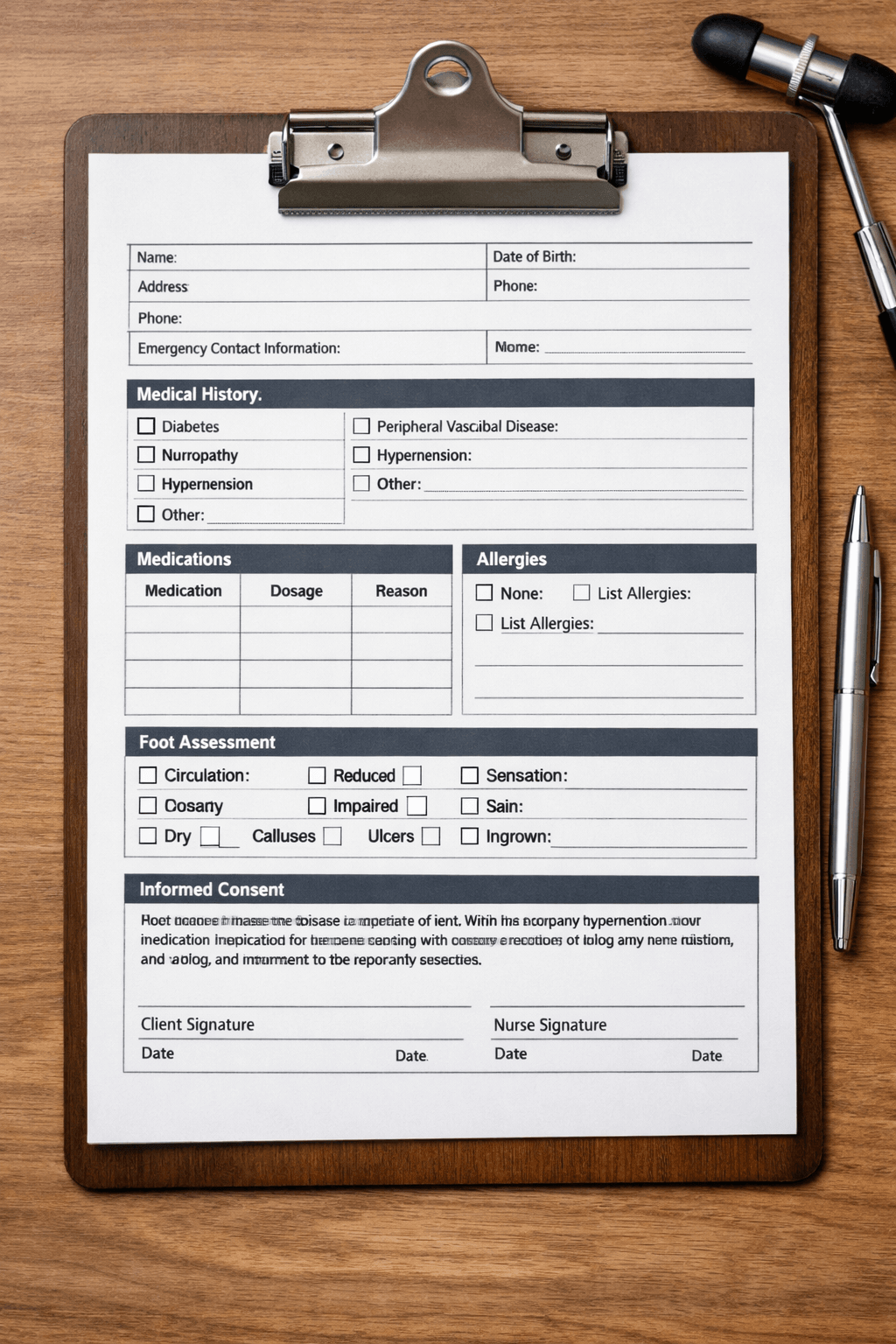
Health Intake Forms for Foot Care Nursing Practice are structured documents used to collect comprehensive client health information before providing foot care services. These forms typically include:
Demographic information
Relevant medical history
Current diagnoses
Medications and allergies
Circulatory and neurological status
Skin integrity concerns
Previous foot complications
Consent to treatment
Emergency contact information
In foot care nursing, intake forms are not simply administrative paperwork. They are clinical tools that support assessment, risk identification, and safe care planning.
A properly designed intake form allows the nurse to:
Identify contraindications or precautions
Recognize infection risks
Assess vascular and neuropathic status
Determine the need for referral
Document informed consent
Why Health Intake Forms for Foot Care Nursing Practice Matter
Health Intake Forms for Foot Care Nursing Practice contribute to multiple aspects of professional nursing care.
1. Client Safety
Foot care procedures, including nail reduction and callus management, may appear routine. However, clients with diabetes, anticoagulant therapy, or compromised circulation require careful assessment before intervention.
Structured intake supports early identification of:
Impaired wound healing risk
Bleeding risk
Active infections
Undiagnosed skin lesions
History of ulceration
Clear documentation improves clinical decision-making and reduces preventable complications.
2. Professional Accountability
Canadian nursing regulatory bodies emphasize accurate documentation as a professional responsibility. Intake forms create a record of:
Information disclosed by the client
Clinical findings
Education provided
Consent obtained
Documentation supports transparency and continuity of care. Scope of practice varies by province and employer, and nurses are responsible for practising within those parameters.
Completion of education does not authorize practice beyond regulatory standards.
3. Ethical Informed Consent
Informed consent is an ongoing process, not a signature alone. A comprehensive intake form can support this process by documenting:
Explanation of procedure
Risks and benefits
Alternatives
Client questions
Voluntary agreement
Ethical nursing practice requires that consent be informed, voluntary, and obtained prior to treatment.
For more on regulatory responsibilities, review our guidance on scope of practice education for foot care nurses and professional accountability standards.
Key Components of Effective Intake Forms
Health Intake Forms for Foot Care Nursing Practice should be structured, clear, and clinically relevant. They must use plain language while allowing space for nursing judgment.
Essential Sections
| Section | Purpose |
|---|---|
| Medical History | Identifies chronic conditions impacting foot health |
| Medication List | Highlights anticoagulants, insulin, immunosuppressants |
| Allergies | Prevents adverse reactions |
| Circulation Screening | Identifies vascular concerns |
| Neuropathy Screening | Detects sensory loss |
| Skin & Nail Assessment | Documents baseline findings |
| Consent Section | Records informed agreement |
Additional Considerations
Space for ongoing updates
Clear date and signature lines
Documentation of referrals if required
Privacy compliance in accordance with provincial legislation
Incorporating infection prevention screening questions also aligns with best practices outlined in infection prevention and medical device reprocessing education resources.
Professional Considerations in Canada
Health Intake Forms for Foot Care Nursing Practice must reflect Canadian regulatory and ethical frameworks.
Scope of Practice
Scope varies by province, territory, and employer policy. Nurses must ensure that assessment and interventions remain within their authorized scope.
Education in foot care nursing supports competence development but does not replace regulatory authorization.
The AFCN Learning Institute education hub provides foundational information on professional standards in foot care settings.
Documentation Standards
Regulators across Canada emphasize that documentation must be:
Accurate
Timely
Objective
Legible
Secure
Intake forms should complement, not replace, ongoing clinical notes.
Privacy and Confidentiality
Health information must be collected and stored in accordance with applicable provincial privacy legislation (e.g., PHIPA in Ontario, HIA in Alberta).
Nurses are responsible for safeguarding personal health information in both paper and digital formats.
Common Misconceptions
“Intake Forms Are Only for Legal Protection”
While documentation contributes to professional accountability, the primary purpose is clinical safety and informed care. Intake forms support assessment and risk identification first.
“Healthy Clients Do Not Need Detailed Intake”
Even clients who appear healthy may have undisclosed conditions or medications affecting treatment. Consistent documentation promotes equitable care.
“Consent Is Just a Signature”
Consent must include an explanation and opportunity for questions. A signed form without discussion does not meet ethical standards.
Education and Clinical Competence
Health Intake Forms for Foot Care Nursing Practice should align with current evidence-informed education. Nurses developing or revising intake documents benefit from reviewing:
Foundational foot care nursing education
Clinical skills and tools education resources
Professional development for returning-to-practice nurses
Education enhances clinical reasoning, particularly in recognizing risk factors such as peripheral arterial disease or neuropathy.
Ongoing competency development supports accurate assessment and documentation quality.
Key Takeaways
Health Intake Forms for Foot Care Nursing Practice support safe, ethical, and accountable nursing care.
Comprehensive intake documentation improves risk identification and care planning.
The scope of practice varies across Canada and must guide all foot care interventions.
Informed consent is a clinical and ethical process, not just a signature.
Proper documentation strengthens continuity of care and professional standards.
Conclusion
Health Intake Forms for Foot Care Nursing Practice are essential components of responsible nursing documentation in Canadian foot care settings. They support structured assessment, ethical consent, and safe clinical decision-making.
When aligned with provincial regulations, infection prevention standards, and professional documentation requirements, intake forms enhance both client safety and nursing accountability.
As with all aspects of nursing practice in Canada, the scope of practice varies by province and employer. Education strengthens competence but does not grant independent authorization beyond regulatory standards.
Thoughtful documentation reflects the professional commitment of nurses to safe, ethical, and evidence-informed foot care practice.
https://www.afcnlearninginstitute.com/products/digital_downloads/informed-consent-health-intake-form
FAQs
What should be included in a foot care nursing health intake form?
A health intake form should include medical history, medications, allergies, circulation and neuropathy screening, skin assessment, and documented informed consent.
Are health intake forms legally required in Canada?
Regulatory bodies require accurate documentation. While specific forms may not be mandated, comprehensive documentation is a professional responsibility.
Does completing a foot care course authorize independent practice?
No. Education supports competence development. Authorization to practise is determined by provincial regulatory bodies and employer policies.
How often should intake information be updated?
Health information should be reviewed and updated at each visit or whenever a client’s condition changes.