
Table of Contents
Foot Care Reprocessing Policy Manual Canada
In community and clinical foot care nursing practice, infection prevention and control is foundational to client safety. A Foot Care Reprocessing Policy Manual Canada provides structured guidance for cleaning, disinfection, sterilization, documentation, and quality assurance processes within a nursing foot care business. For Canadian nurses, having clearly written reprocessing policies supports regulatory accountability, public health alignment, and safe clinical operations.
Foot care nurses routinely use reusable medical devices such as nail nippers, curettes, and rotary instruments. These devices require validated reprocessing procedures consistent with provincial public health standards. A written manual formalizes those procedures and provides consistent direction for staff and contractors.
Key Concepts in a Foot Care Reprocessing Policy Manual Canada
A Foot Care Reprocessing Policy Manual Canada outlines standardized processes for:
Cleaning and decontamination
Inspection and packaging
Sterilization methods
Storage and handling
Documentation and record keeping
Equipment maintenance
Biological and chemical monitoring
Incident reporting
Reprocessing refers to the validated steps taken to make a reusable medical device safe for its next use. In Canadian foot care settings, this typically involves cleaning, ultrasonic processing (if applicable), packaging, steam sterilization, drying, storage, and monitoring.
Nurses should be familiar with Spaulding’s classification system, which categorizes medical devices as critical, semi-critical, or non-critical. Most foot care instruments that contact blood or sterile tissue are considered critical devices and require sterilization.
Clear policies help ensure consistency, especially in independent practice settings where nurses are responsible for both clinical care and operational oversight.
Professional Considerations for Canadian Nurses
Scope of Practice and Regulatory Accountability
When developing or implementing a Foot Care Reprocessing Policy Manual Canada, nurses must understand that scope of practice varies by province, territory, and employer. Provincial regulatory colleges set expectations for infection prevention and control. Public health units may also conduct inspections in certain jurisdictions.
Completing education in medical device reprocessing does not independently authorize a nurse to practise beyond their regulated scope. Nurses remain accountable to:
Their provincial regulatory body
Employer policies (if applicable)
Public health requirements
Evidence-informed infection prevention standards
For guidance on role clarity, nurses may review AFCN’s scope of practice education resources.
Safety and Risk Management
A structured reprocessing manual supports:
Reduced risk of cross-contamination
Standardized workflow
Traceability of sterilization cycles
Clear delegation boundaries
Quality improvement auditing
Incorporating logs for biological indicators, sterilizer maintenance, and load records helps demonstrate due diligence. Nurses seeking deeper clinical context may consult AFCN’s infection prevention and medical device reprocessing education.
Ethical and Documentation Standards
Ethical nursing practice includes transparency, competence, and commitment to client safety. Written reprocessing policies demonstrate that a nurse has proactively considered risk mitigation.
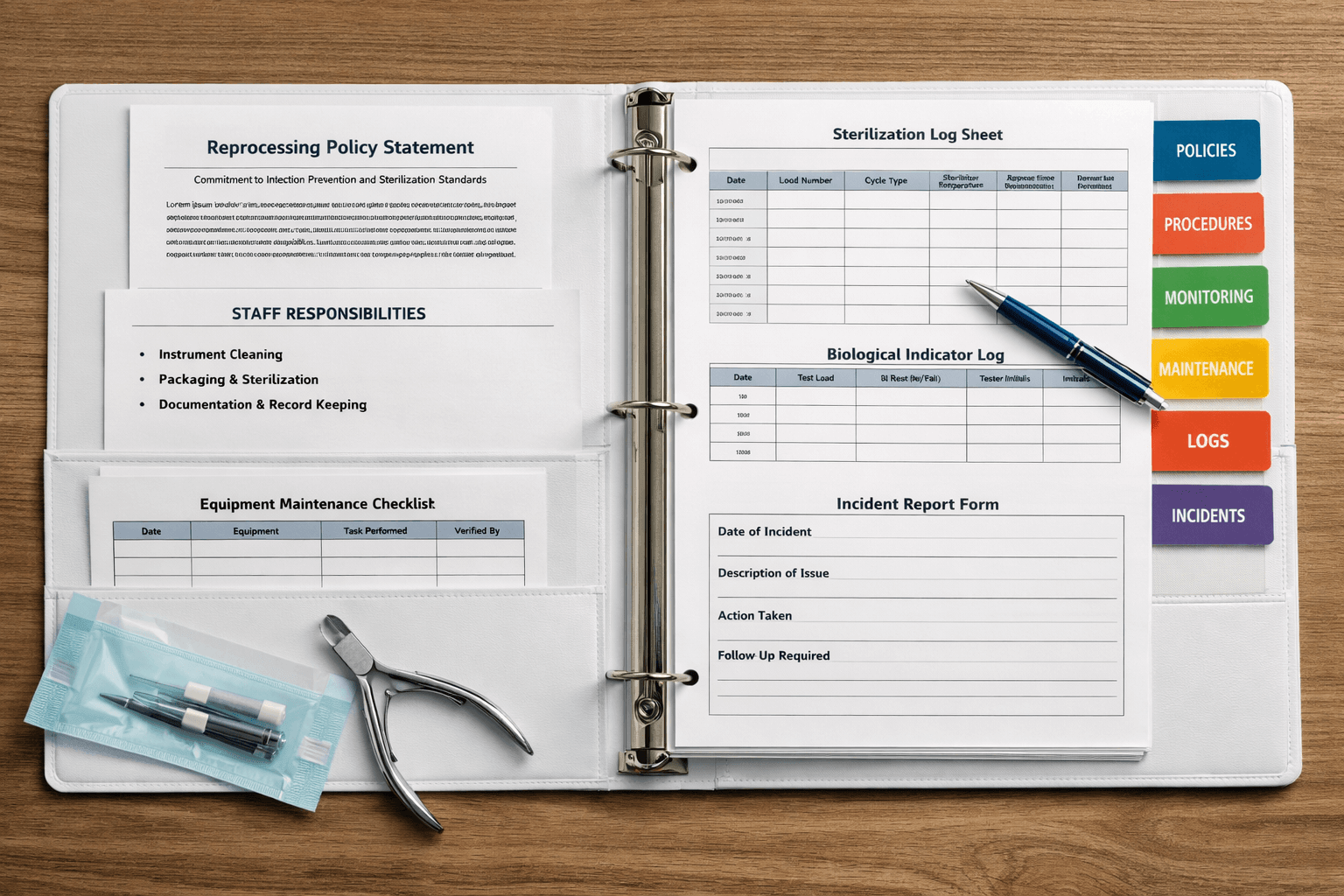
Documentation within a reprocessing binder typically includes:
Sterilizer cycle logs
Chemical indicator results
Biological indicator records
Equipment servicing records
Incident or recall procedures
Nurses operating independently may benefit from structured templates aligned with AFCN’s clinical skills and tools education.
Common Misconceptions
Some nurses assume that informal routines are sufficient if they have always “done it that way.” However, a Foot Care Reprocessing Policy Manual Canada formalizes practice expectations and provides a defensible framework if inspected or audited.
Another misconception is that purchasing a sterilizer alone ensures compliance. Sterilization is only one component of the reprocessing cycle. Without documented cleaning protocols, monitoring processes, and staff training, compliance gaps may remain.
It is also incorrect to assume that completing a course automatically guarantees approval from regulators or public health authorities. Education supports competence, but authorization to practise and business compliance are determined by provincial standards and local oversight.
For nurses returning to independent practice, AFCN’s returning-to-practice resources provide additional professional context.
Education and Competency Development
Developing or implementing a Foot Care Reprocessing Policy Manual Canada requires knowledge in:
Microbiology principles
Sterilization science
Equipment validation
Quality assurance systems
Occupational health and safety
Continuing professional development supports safe integration of reprocessing standards into daily practice. AFCN’s foundational foot care nursing education introduces core competencies required before expanding into independent foot care business operations.
Nurses are encouraged to regularly review public health updates and manufacturer instructions for use (IFUs) for all medical devices and sterilization equipment. Policies must reflect current evidence and equipment specifications.
Importantly, policies should be reviewed annually or when equipment, guidelines, or legislation changes.
Practical Structure of a Reprocessing Binder
A typical binder aligned with a Foot Care Reprocessing Policy Manual Canada may include the following sections:
| Section | Purpose |
|---|---|
| Policy Statement | Defines commitment to infection prevention |
| Roles & Responsibilities | Clarifies accountability |
| Reprocessing Workflow | Step-by-step procedures |
| Monitoring & Testing | Biological and chemical indicator processes |
| Documentation Logs | Record-keeping templates |
| Equipment Maintenance | Servicing schedules |
| Incident Management | Response to sterilization failure |
Clear indexing allows inspectors or auditors to quickly locate documentation.
Integration Into Clinical Workflow
A Foot Care Reprocessing Policy Manual Canada should align with daily scheduling, instrument flow, and storage design. Considerations include:
Separation of clean and dirty zones
Adequate drying time before storage
Safe transport of contaminated instruments
Secure storage of sterile packages
Staff training and competency validation
For nurses building or refining systems, AFCN’s education hub offers broader professional development resources.
Reprocessing policies should be practical, not theoretical. They must reflect the actual equipment, layout, and workflow of the specific clinical environment.
In addition, nurses should ensure that all staff members involved in instrument handling receive documented training and periodic competency validation. Written orientation checklists and annual review processes further strengthen accountability within a Foot Care Reprocessing Policy Manual Canada framework. Clear documentation of training dates and competency assessments supports transparency during public health inspections and reinforces a culture of safety within the clinical environment.
Key Takeaways
A Foot Care Reprocessing Policy Manual Canada supports infection prevention and regulatory accountability.
The scope of practice and inspection requirements vary by province and employer.
Sterilization is one component of a complete reprocessing system.
Documentation, monitoring, and annual review are essential for quality assurance.
Education strengthens competence but does not independently grant authorization to practise.
Closing Perspective
Safe foot care nursing practice in Canada requires structured systems, professional accountability, and ongoing education. Written reprocessing policies help nurses demonstrate due diligence, support public health alignment, and maintain consistent standards of care. Nurses are encouraged to consult provincial regulators and public health authorities to ensure that their policies reflect current expectations within their jurisdiction.
FAQs
What is included in a foot care reprocessing policy manual?
It typically includes written cleaning and sterilization procedures, monitoring logs, equipment maintenance schedules, and incident management processes.
Does completing reprocessing education authorize independent practice?
No. Education supports competence, but authorization to practise depends on provincial regulatory standards and employer policies.
How often should sterilization policies be reviewed?
Policies should be reviewed at least annually or whenever equipment, legislation, or public health guidance changes.
Are reprocessing requirements the same across Canada?
No. Requirements vary by province, territory, and local public health authorities. Nurses must verify standards within their jurisdiction.